Spring Speaker Series: Antoine Courmont on big data, Waze, and local governance
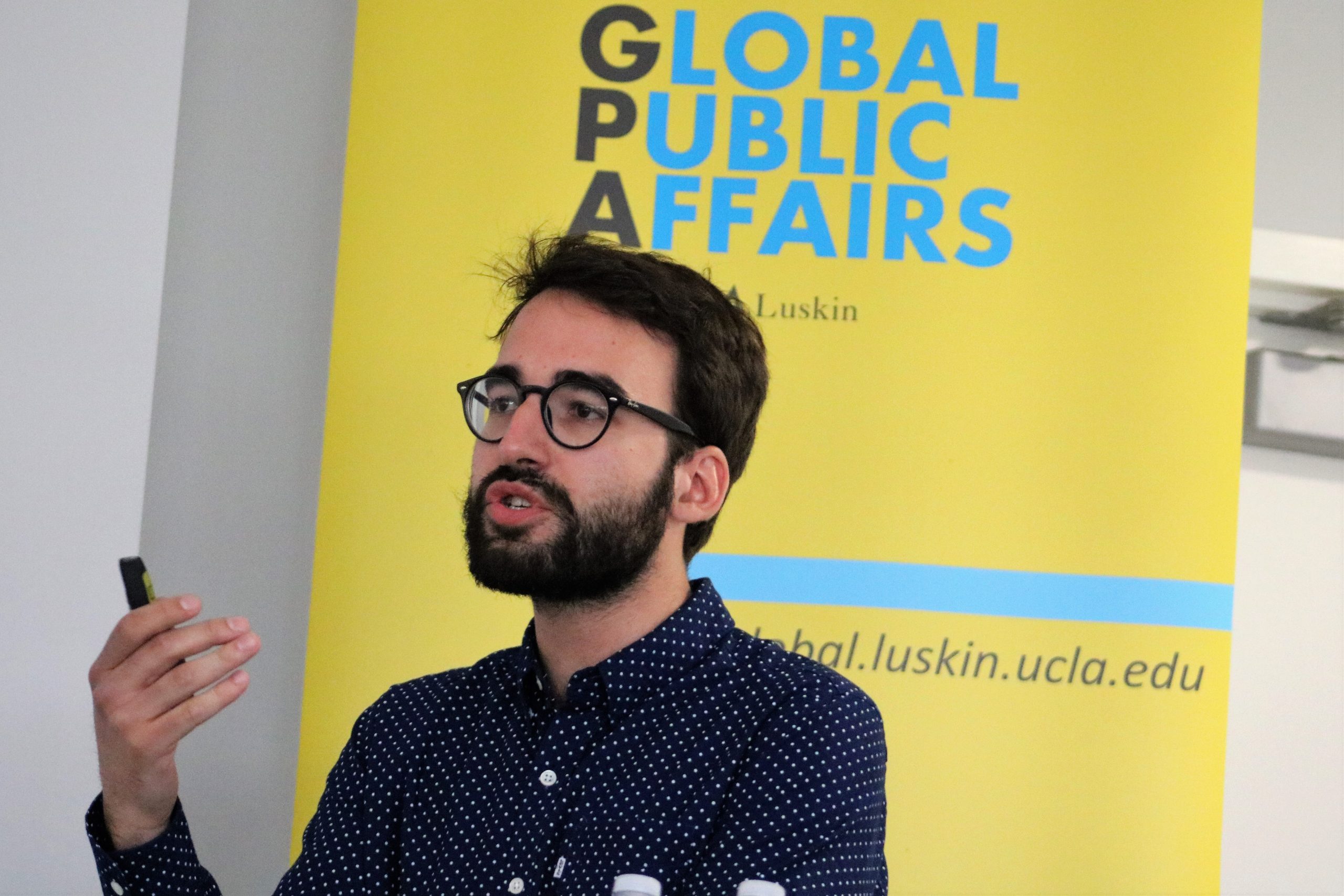
ITS and Global Public Affairs at UCLA Luskin co-hosted a lecture by Antoine Cormount, cities and digital technology chair at the Sciences Po in Paris, as part of the spring transportation speaker series. Courmont’s discussion, “Big Data and Re-composition of Urban Governance in the Digital Era: The Case of the Waze App,” focused primarily on the potential for conflict between public and private goals when firms and governments use different data sets.
Watch the full presentation:
The popular driving app Waze, Courmont explained, relies heavily on real-time crowdsourced data that is applied to help its users shorten commute times. Conversely, government-backed infrastructure like traffic cameras and roadway sensors are often employed to help reduce congestion rather than short-term drive times. Because Waze will often route drivers through residential streets — clogging roads not designed for commuter traffic, the spillover effect from Waze’s data gathering causes regional traffic problems, governments say. Waze contends that poor urban planning has led to a need for its commute-shortening algorithms. Governments can implement a number of policies that could reduce Waze’ effectiveness, Courmont said. He also noted that Waze and governments have the potential to collaborate, share data and disseminate information on road closures and traffic hazards.
This post has been lightly edited from its original version by Zev Hurwitz on the website of the UCLA Luskin School of Public Affairs. View additional photos from the presentation in a Flickr album.
Recent Posts

What if transportation abundance policy focused on access, not just mobility?
A transportation abundance agenda means rethinking investment and management so people can reach what they need, not just move faster or farther through inefficient systems.
UCLA student wins fourth consecutive national transportation prize
Nick Giorgio MURP ‘25 received the Neville Parker Award for his capstone project on intersection design and safety in Los Angeles.

Featured Content