UCLA Mobility Center receives $2.5 million federal grant to advance cooperative perception technology
The Federal Highway Administration, an agency within the U.S. Department of Transportation, has awarded a three-year, $2.5 million grant to UCLA’s Mobility Center of Excellence for testing and developing cooperative perception technologies — systems that allow vehicles, other road users and transportation infrastructure to share information about their surroundings.
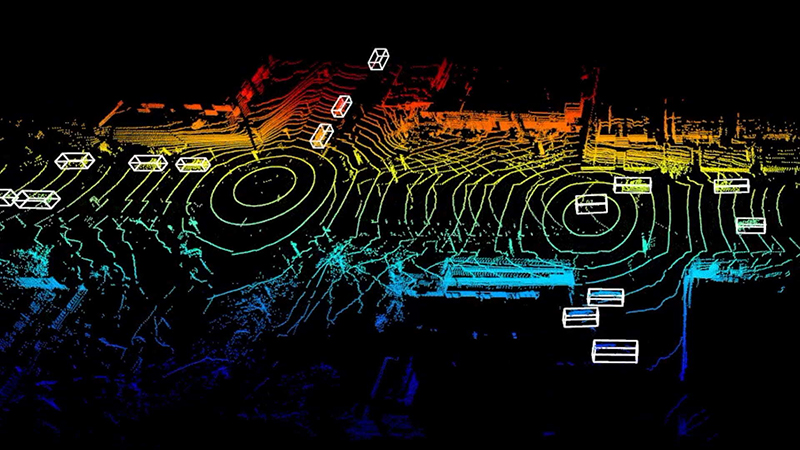
Cooperative perception enables cars, pedestrians, traffic signals, roadside cameras and other infrastructure to communicate with one another and build a broader awareness of their surroundings. Instead of detecting only what is directly within a single vehicle’s sensor range, the technology can provide a shared, large-scale perception map of the roadway environment. These expanded capabilities could improve the safety and efficiency of self-driving and driver-assisted vehicles as well as the broader transportation network. The goal of the new FHWA grant is to expedite the commercial deployment of these technologies.
Cooperative perception in action at a UCLA test intersection, with smart infrastructure and CAVs exchanging camera and lidar data (The Mobility Lab/UCLA)
“Today’s automated vehicles already have a wide range of advanced safety features. But they still operate independently within their own sensor range,” said principal investigator and Mobility Center of Excellence director Jiaqi Ma, a professor of civil and environmental engineering and director of the Mobility Lab at the UCLA Samueli School of Engineering. “Cooperative perception enables multiple vehicles, other road users, sensors and infrastructure units to share what they see in real time so each one gains a broader, unified view of the surroundings. This is especially important for safer navigation in poor visibility or dense traffic.” Ma also serves as associate director of the UCLA Institute for Transportation Studies.
Researchers at the center will test cooperative perception algorithms using connected and automated vehicles and infrastructure on a closed track and the Smart Intersection at UCLA, a real-world, multi-agent, multimodal vehicle-to-everything cooperative perception application for autonomous driving developed by the Mobility Lab. They will collaborate with industry experts and other stakeholders on the system design and implementation in real-world settings. The team will quantify safety, mobility and economic impacts of cooperative perception technologies and ensure they integrate seamlessly with existing communication and control systems. The researchers will also work with multiple industry partners to perform interoperability testing of various cooperative perception systems to ensure they function reliably across different devices and environments, enabling scalable deployment in real-world transportation networks.
Established in 2023 through a five-year, $7.5 million grant from the Federal Highway Administration, the Mobility Center of Excellence spans the full innovation pipeline — developing advanced mobility and automated vehicle and mobility technologies, facilitating their deployment and assessing their impacts on land use, urban design, transportation systems, real estate and municipal budgets.
Featured image: Light detection and ranging data from multiple connected and automated vehicles combined to create a single, large-scale perception map of the roadway (The Mobility Lab/UCLA)
A version of this article originally appeared on the UCLA Samueli website.
Recent Posts

What if transportation abundance policy focused on access, not just mobility?
A transportation abundance agenda means rethinking investment and management so people can reach what they need, not just move faster or farther through inefficient systems.
UCLA student wins fourth consecutive national transportation prize
Nick Giorgio MURP ‘25 received the Neville Parker Award for his capstone project on intersection design and safety in Los Angeles.

Featured Content