Meet the manager of UCLA’s new Center for Parking Policy

Three years after earning her master’s degree, Ellen Schwartz MURP ‘22 has returned to UCLA as the inaugural manager of the new UCLA Center for Parking Policy.
Launched summer 2025, the center aims to carry on the global parking reform movement sparked by Donald Shoup by translating research into action, shaping public policy, and training the next generation of “Shoupistas.” In her role, Schwartz provides technical assistance to local and state officials throughout the policymaking process — from evaluation to implementation.
Parking played a major role in Schwartz’s decision to study at UCLA. As a MURP student, she concentrated in transportation policy and planning and worked as a student editor with Shoup, whose mentorship deepened her understanding of parking reform and strengthened her writing skills. After graduating, she continued her work in the field as curb, mobility, and parking planner at Walker Consultants, where she advised public sector clients on transportation and land use plans, including parking management frameworks and development review policies.
Returning to Westwood, Schwartz looks forward to picking up where she left off.
The following Q&A has been edited for length and clarity.
What originally sparked your interest in parking?
In 2015, I lived in Verona, Italy for several months. I loved living there and how walkable it was, but I never really made the connection between walkability and parking until I read Jeff Speck’s Walkable City. Next thing you know, I was reading about parking all the time. I read Donald Shoup’s The High Cost of Free Parking and started reading other articles about parking from the University of California’s ACCESS Magazine.
Learning how parking was connected to almost every issue I cared about inspired me to go to graduate school so I could work on parking policy reform, and I sought out UCLA specifically because of Professor Shoup. While I was at UCLA, I was fortunate to be able to take his class on parking and work for him as a student editor. I wrote almost all of my papers for other classes about parking in some way. If there was a way to tie it in, I did.
What were some skills or ideas you took away from your time working with Professor Shoup as a student editor?
My biggest takeaway was his famous motto: “Easy reading is hard writing.” It was incredible to see how many drafts he used before he published something. Seeing his editing process really inspired me to try to put more thought into my own writing and say things in the clearest way possible. It was also just fun to work for him, partly because I loved the subject, and partly because he was just so encouraging. I’m really grateful I had that experience working with him.
How does it feel to be back at UCLA?
I’ve really appreciated being back in an academic environment and diving back into research. Since I graduated, several more cities have eliminated parking requirements, so there are some new results to share, and I’m excited to be able to help make that research more accessible. As I’m working on synthesizing research, I’ve also had the chance to meet some of the researchers whose papers I’ve read as a student. It definitely feels like a full-circle moment.
What is it like being part of a brand new research center?
It’s very exciting. I was also excited about the opportunity to work with Michael Manville, Adam Millard-Ball, and Juan Matute, who I took classes with and really respected during my time at UCLA. There are so many things that we would love to do, so one of the challenges is prioritizing what to do first. One thing that has helped to guide us as we start out is a survey we created to get a sense of what would be most helpful to our audience. So far, the respondents have been mostly planners, along with some residents, advocates, and decision-makers.
What else can you tell us about some of the early survey responses?
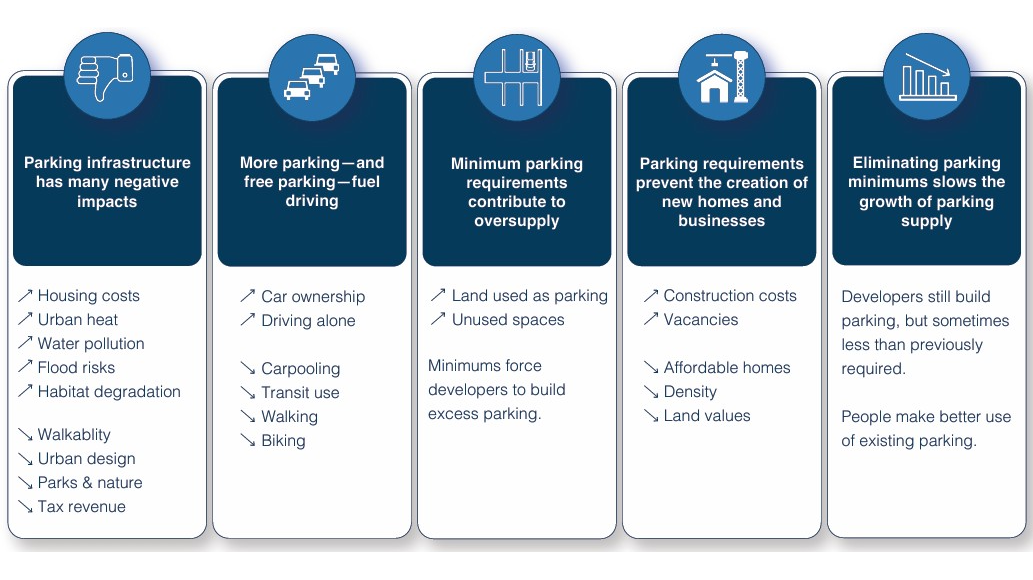
Parking management issues came up repeatedly in open-ended questions. We listed several different types of resources and topics that people could rank to let us know what would be most helpful to them, and the clear winner has been research summaries. For example, many people were interested in a research summary related to parking policy and economic vitality, which hasn’t received quite as much research attention as other policy outcomes have, so that could potentially provide some direction for where we focus our case study efforts. There was also a lot of interest in research on the impacts of parking and the results of removing parking minimum requirements, which was a factor in selecting the topic for our first research synthesis, which I’m working on now.
What kinds of projects is the Center for Parking Policy currently working on and how do you hope to see this work grow in the future?
We have a few great projects happening right now. We recently hosted an online mini-symposium, where speakers from cities across the United States shared success stories and lessons they have learned since eliminating parking requirements. Another virtual education opportunity we’ll be working on soon is creating a short course for planners. Adam Millard-Ball will be taking over teaching Professor Shoup’s parking course next year, and we’d like to make some of these video lectures available on our website for anyone to access. We would like to create a new course for Planetizen as well, so planners can receive credit.
Something else I’m excited about is our new Parking Research Collaborative, which we hope will help spark new research on parking policy. We held a small, in-person workshop for academics to discuss the research agenda for parking policy, and already two new collaborative papers are in the works. We also created a new Google Group for researchers across the country who are interested in parking to stay connected and share ideas. And ideally, it will also become a space where we can link researchers with city staff or parking technology companies that are open to collaborating and sharing data and on-the-ground experiences.
On our website, we added a Parking Help Desk, inviting people to email us for guidance and to be connected with resources relevant to their situation. Longer term, we plan to keep creating policy briefs, research summaries, and other materials that help bridge the gap between research and practice, and to build a user-friendly website with resources and information organized both by policy and by goal so people can easily find what they need. We also plan to organize more events and opportunities that bring people together and spread the word about parking reforms. Overall, this is all just a great way to carry on Shoup’s legacy and make sure parking gets the attention it deserves.
How can someone interested in the center’s work get in touch with you?
Feel free to send me an email at ellenschwartz@g.ucla.edu!
Learn More and Get Involved
Support the Center for Parking Policy >>
Share your parking issues and needs >>
Subscribe to the Center for Parking Policy mailing list >>
Follow the center on LinkedIn >>
Photo: Donald Shoup and Ellen Schwartz at UCLA (courtesy of Ellen Schwartz)
Recent Posts

What if transportation abundance policy focused on access, not just mobility?
A transportation abundance agenda means rethinking investment and management so people can reach what they need, not just move faster or farther through inefficient systems.
UCLA student wins fourth consecutive national transportation prize
Nick Giorgio MURP ‘25 received the Neville Parker Award for his capstone project on intersection design and safety in Los Angeles.

Featured Content