

Date: November 20, 2025
Author(s): Megan Mullin, Colleen Callahan, Elena Hernandez, Naomi Rosen, Arushi Somani
Abstract
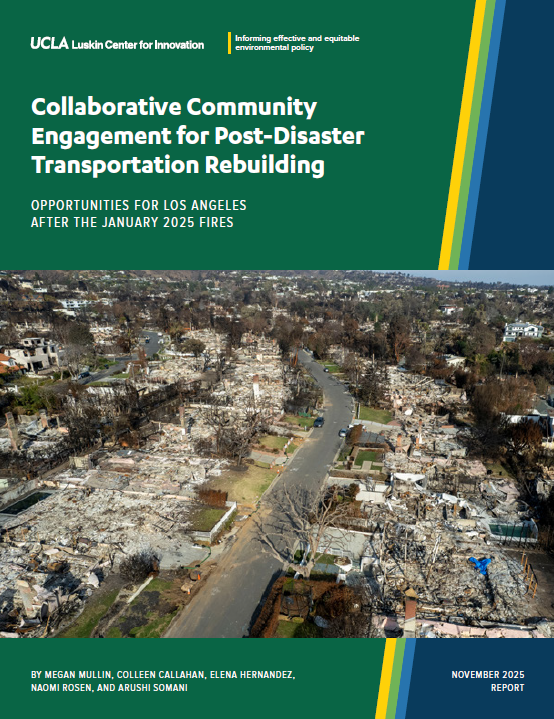
The January 2025 Eaton and Palisades fires revealed how urgently transportation systems must recover — and how quickly a rush to rebuild can entrench old risks. This report examines how collaborative community engagement can shape safer, more equitable transportation rebuilding and evacuation planning in Los Angeles. Drawing on literature, public agency records, and interviews with transportation professionals, fire survivors, and community leaders, the research explores whether California’s Transformative Climate Communities (TCC) model can guide post-fire recovery. Findings show that rapid, like-for-like restoration often precludes safer designs and multimodal options; effective rebuilding requires cross-agency coordination, integration of evacuation needs into transportation planning, and trauma-informed engagement with residents. Community-based organizations can foster trust and inclusion, but need compensation and support to participate meaningfully. The TCC model offers adaptable structures — collaborative visioning, shared governance, and flexibility — that could strengthen post-disaster recovery if scaled to faster timelines. This research calls on policymakers and practitioners to embed community priorities in transportation decisions, align funding to sustain partnerships, and rebuild for long-term resilience rather than short-term restoration.
About the Project
A race to rebuild transportation infrastructure may preclude or increase the cost of other community-defined priorities that could emerge during the long recovery process. Once roadway repairs and reconstruction are […]