

October 31, 2022
Abstract
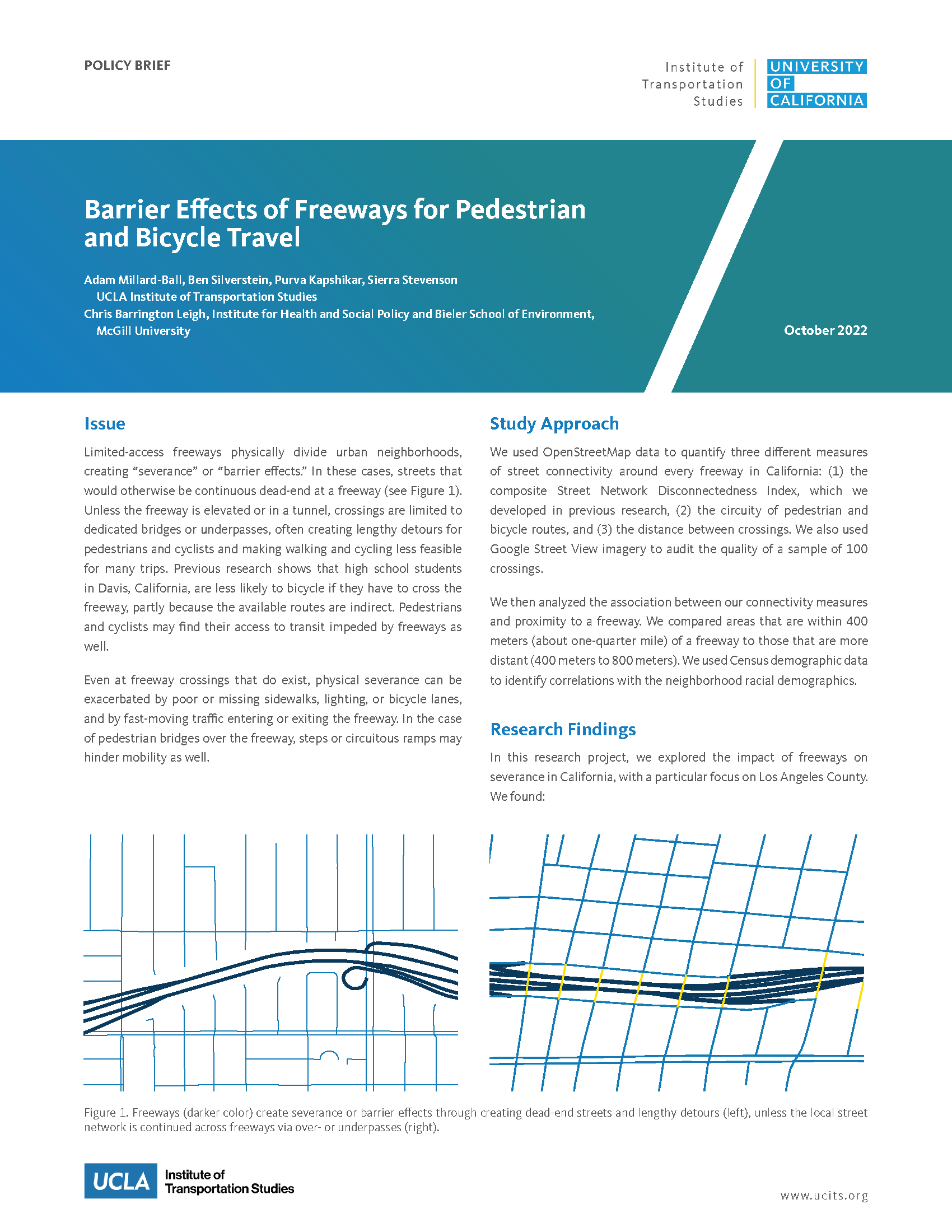
We examine the barrier effects of freeways in California. We analyze the association between freeways and three measures of nearby street connectivity: the composite Street Network Disconnectedness index (SNDi), circuity, and the distance between crossings – underpasses or bridges that enable people to cross the freeway. We also assess the quality of a sample of these crossings for pedestrians and cyclists. We find that barrier effects are most pronounced in communities of color. We also find that even where crossings exist, they are unpleasant or even hazardous for pedestrians and cyclists because of high-speed traffic on on- and off-ramps, and because large volumes of traffic are funneled through a small number of crossings rather than being distributed over a wider network.
Research Project
Related Publications
November 7, 2022
September 1, 2025