

Date: February 26, 2020
Author(s): Jacob L. Wasserman, Brian D. Taylor, Evelyn Blumenberg, Mark Garrett
Abstract
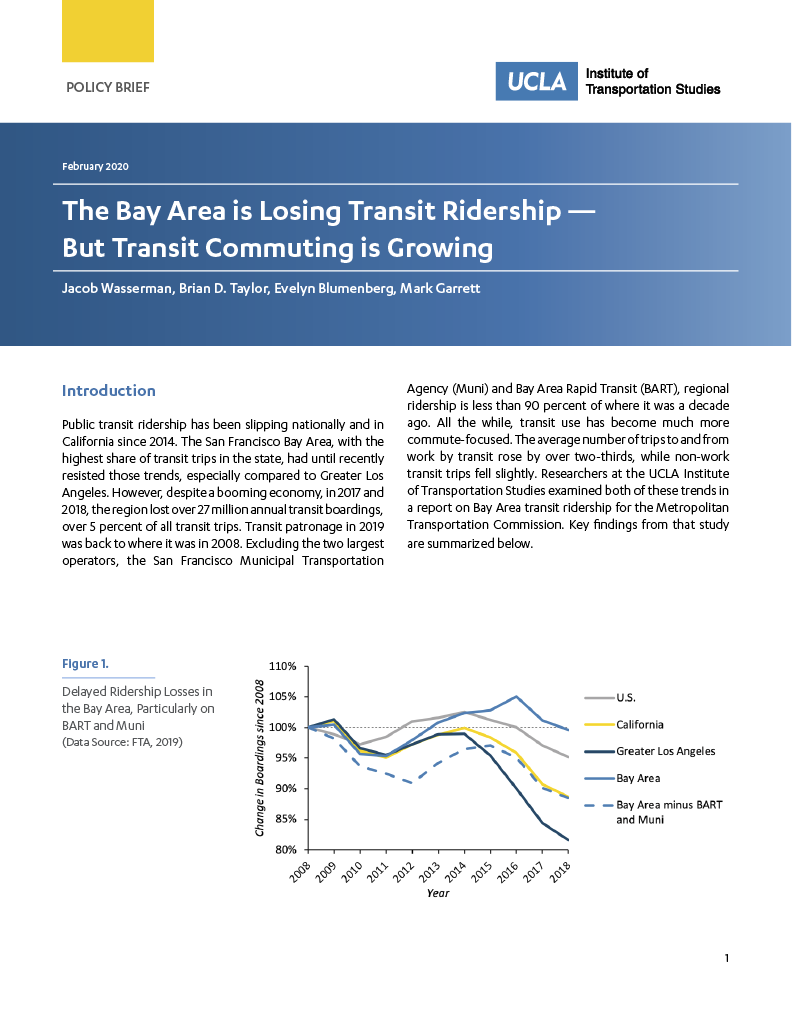
Public transit ridership has been slipping nationally and in California since 2014. The San Francisco Bay Area, with the highest share of transit trips in the state, had until recently resisted those trends, especially compared to Greater Los Angeles. However, despite a booming economy, in 2017 and 2018, the region lost over 27 million annual transit boardings, over 5 percent of all transit trips. Transit patronage in 2019 was back to where it was in 2008. Excluding the two largest operators, the San Francisco Municipal Transportation Agency (Muni) and Bay Area Rapid Transit (BART), regional ridership is less than 90 percent of where it was a decade ago. All the while, transit use has become much more commute-focused. The average number of trips to and from work by transit rose by over two-thirds, while non-work transit trips fell slightly. This research finds that even before the recent dip in total ridership, individual transit use was edging downward — falling from 72 annual trips per Bay Area resident in 2008 to just 65 in 2018. Across operators, rail ridership (especially heavy rail like BART) has increased over the past decade (before the recent dip), but bus patronage has declined.
About the Project
Public transit ridership has been falling nationally and in California since 2014. The San Francisco Bay Area, with the state’s highest rates of transit use, had until recently resisted those […]