


This is a web-based policy brief with an automatically generated pdf file.
Evacuation Patterns, Health Risks, and Mobility Strategies Among Transit Riders in the 2025 L.A. Fires
September 12, 2025
Introduction
Fast-moving wildfires pose significant challenges to evacuation, especially for transportation-insecure households with limited access to personal vehicles. The January 2025 Los Angeles fires marked a rare and alarming shift in wildfire events: blazes spread into highly populated urban areas across Los Angeles County, forcing tens of thousands of residents in the Pacific Palisades, Altadena, and parts of Hollywood communities to flee with little notice. Smoke from the fires created widespread health risks, especially for transit riders and people with preexisting health conditions. Yet because no-notice wildfire events have seldom struck urban areas, little is known about how people without reliable access to vehicles evacuate — or the health challenges they face when doing so.
In response, this policy brief highlights key findings from a survey conducted through the Transit app in February 2025, collected among transit riders who did and did not evacuate. By centering the experiences of Los Angeles’s transit-riding populations amid unprecedented wildfire smoke and mobility disruptions, the findings offer urgent evidence to inform equitable, health‑conscious emergency and evacuation planning for cities across the United States facing future climate-exacerbated wildfire threats.
Research Approach
An online survey was distributed through the Transit app, a mobile application that provides real-time transit arrival and trip-planning information. Because the app has a broad reach within Los Angeles County, it allowed researchers to reach a wide swath of transit riders within a targeted area.
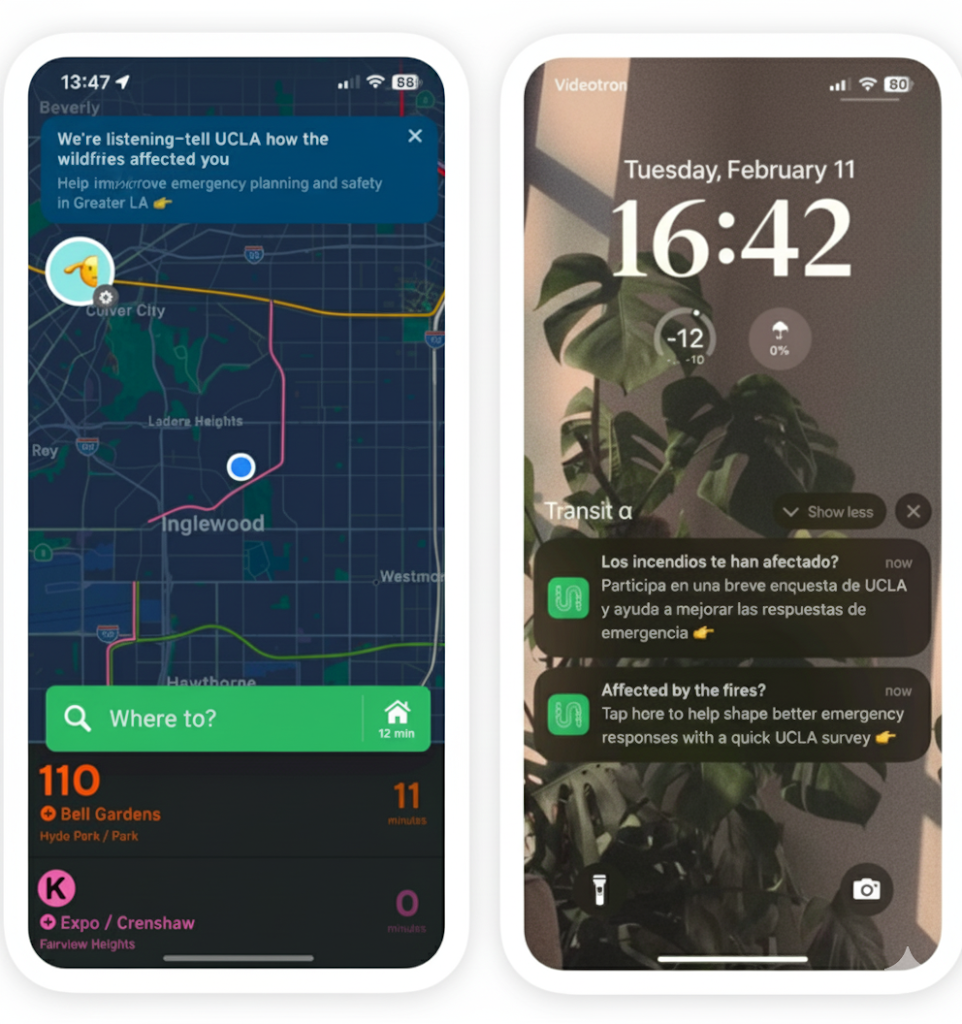
From Feb. 3–12, 2025, the survey was advertised via an in-app banner (Figure 1), displayed in English and Spanish to anyone using the app in Los Angeles County. On Feb. 11, a push notification was also sent to users who had actively engaged with the app but had not clicked the banner. Over the nine-day period, we received 623 complete responses, including 26% (n=164) from people who evacuated.
Figure 1: Transit app banner and push notifications
The survey asked all respondents about any health impacts they experienced from wildfire smoke during or after the fires and protective measures they may have taken, including avoiding travel or transit. Evacuees were also asked about their evacuation experiences and challenges, while non-evacuees received a shorter set of questions on health and travel impacts. Those who completed the survey received $10 gift cards as a token of appreciation.
Key Research Findings
The most common way that transit riders evacuated was by getting rides from other people, though patterns vary across groups. Overall, 28% of respondents relied on rides from others, and 21% used transit to evacuate. Black respondents were most likely to evacuate via transit (42%), followed by people who don’t own cars (26%) and low-income households (25%). White and higher-income respondents were most likely to evacuate using their own vehicles (Figure 2).
Figure 2: Evacuation modes by subgroups
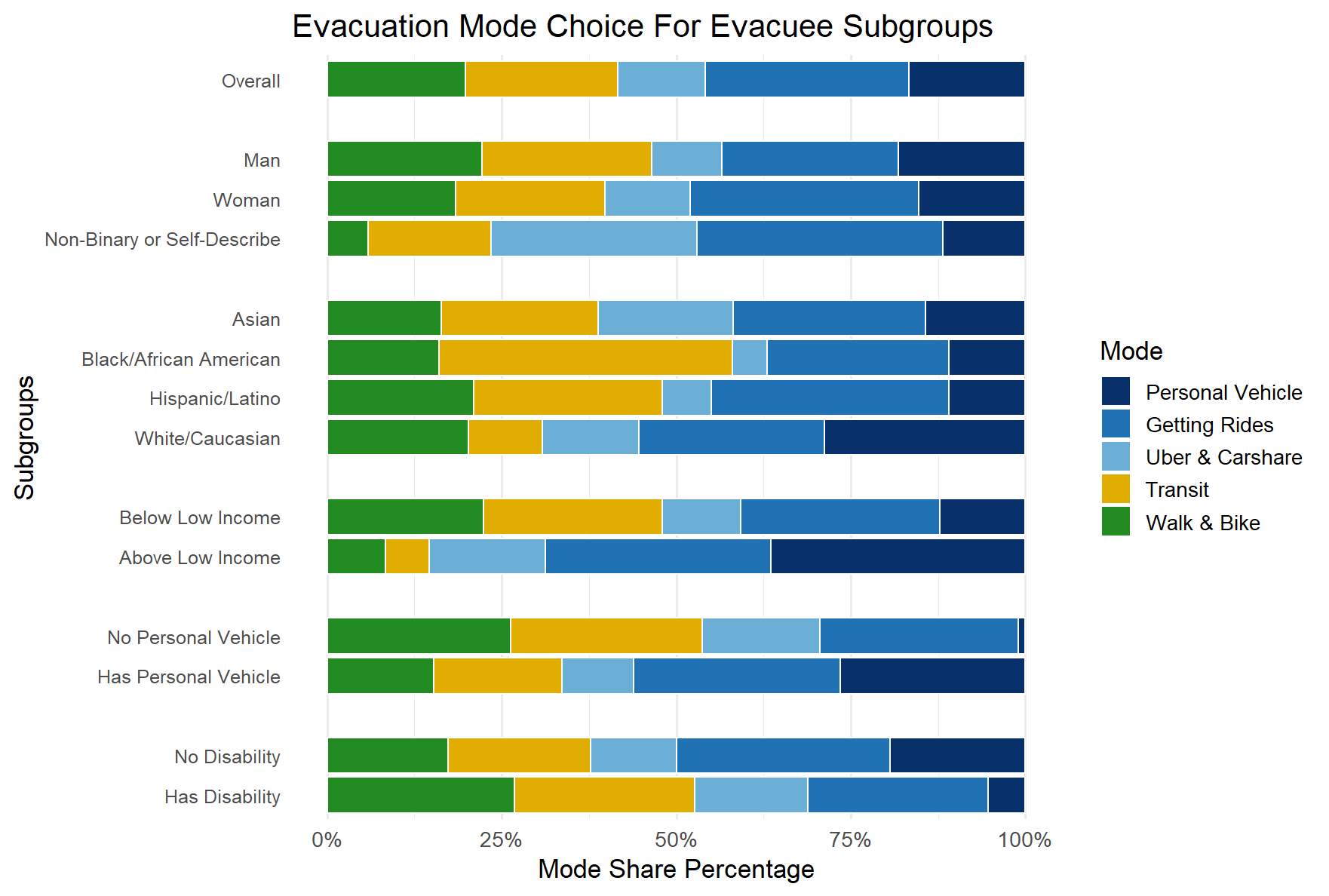
Half of evacuees reported taking more than an hour to reach safety during the evacuation. Prolonged evacuations were especially common among non-binary individuals (75%), Black and Asian evacuees (54% each), and those without access to personal vehicles (52%). Longer evacuation times also meant greater exposure to smoke, debris, and fine particulate matter (PM2.5), particularly for people relying on public transit or walking. Overall, 39% of respondents reported facing some form of transportation-related difficulty, which was strongly associated with longer evacuation durations.
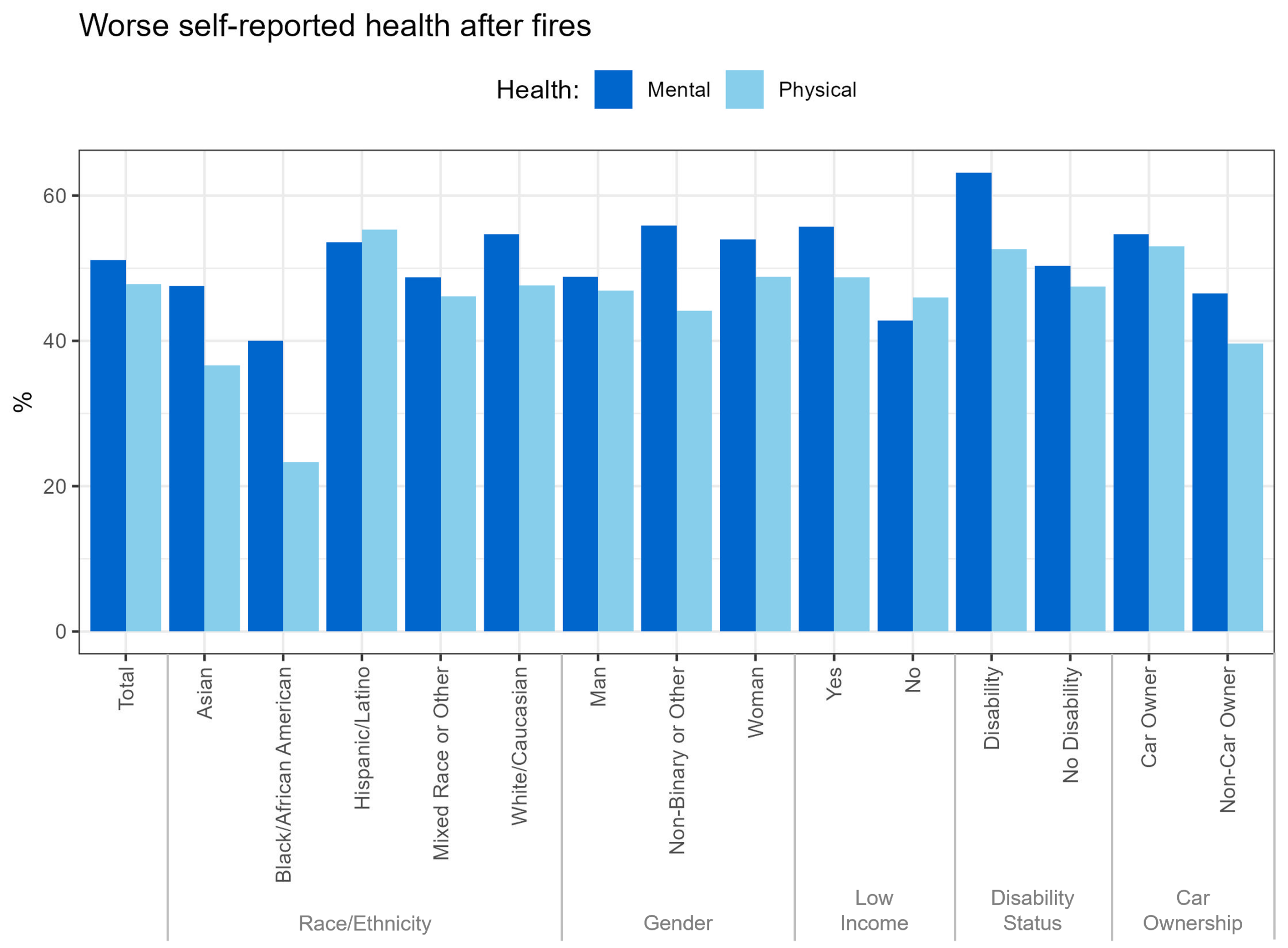
Evacuating from the fires was associated with declines in both physical and mental health. When asked to compare their current health (February 2025) to pre-wildfire periods, 48% of respondents reported declines in their physical health, and 51% reported mental health declines (Figure 3). Surprisingly, evacuees who traveled by car — whether their own, a ride from someone, or ride-hailing services — reported worse physical and mental health conditions after the wildfires compared to people who evacuated by other modes.
Figure 3: Survey respondents reporting worse physical & mental health after the wildfires
One in four respondents avoided using transit after the fires to protect themselves from air pollution. Rates were higher among respondents with asthma (37%), Asian respondents (34%), and people who reported worsening physical health compared to the pre-wildfire periods (30%). Likely associated with avoiding public transit, one in five respondents reported getting rides from someone else to avoid air pollution concerns. The least common protective measure was adjusting the time of trips (10%).
Conclusions and Recommendations
Our findings highlight that transportation vulnerability shapes people’s evacuation experience, even when these disasters strike in relatively affluent areas. Many transit riders relied on getting rides from friends, neighbors, or ride-hailing services, while a significant share depended on public transit or walking. These options were not evenly distributed: Black, Latino, and low-income respondents were disproportionately reliant on non-automobile modes, leaving them more exposed to longer evacuation times and heightened risks from smoke and other hazards. These disparities underscore the need to capture the experiences of transit riders and ensure their needs are understood and reflected in emergency planning.
It is equally important to recognize that no community is a monolith, and some residents require additional support. Within every community, certain groups — older adults, people with disabilities, households with more adults than cars, and those without vehicles — face elevated mobility challenges. Public agencies should continue to identify and develop plans to support these residents during emergencies.
These findings also call into question the assumptions embedded in standard emergency protocols such as “Ready, Set, Go,” which presume that everyone can evacuate on command. Instead, this study suggests that people had to rely on a variety of strategies, including getting rides from people they knew, ride-hailing services, transit, walking, and a combination of modes to get to safety. Those who faced transportation challenges took longer to reach safety, increasing their exposure to air pollution and wildfire smoke.
Based on these findings, the following recommendations are designed to support local governments and agencies in shaping more resilient, equitable emergency planning efforts:
- Transit agencies in California should develop standard messaging that encourages riders to make emergency evacuation plans on “blue sky days” before emergencies occur. These messages should emphasize leaving earlier, anticipating longer travel times, and arranging multiple ride options with friends, family, or neighbors in advance.
- Transit agencies should integrate health strategies into their operations planning. This includes distributing masks at transit hubs, providing clear guidance on the use of protective equipment, and coordinating with other stakeholder groups.
- Local governments should explore creating a voluntary “disaster registry” for people needing additional evacuation assistance. This could be modeled after the EmPOWER program, which is a self-reported database managed locally by the Los Angeles County Department of Public Health and operated nationally by the U.S. Department of Health and Human Services. EmPOWER data are self-reported by people who have medical devices or mobility and health issues, and can distribute special notices in the case of emergencies.
More Information
This policy brief is drawn from the research report “Health and Evacuation Challenges for Transit Riders During the 2025 Los Angeles Wildfires” funded by the Natural Hazards Center. The full report is forthcoming and will be available at https://hazards.colorado.edu/research/public-health-disaster-research/reports. For more information about the findings presented in this brief and the report, please contact Madeline Brozen at mbrozen@ucla.edu.
CITATION
Brozen, M., Kim, S.-O. Dennis-Bauer, S., Goddard, T., Grajdura, S., Lee, A., Miller, R. G., & Palm, M. (2025). Evacuation patterns, health risks, and mobility strategies among transit riders in the 2025 L.A. fires. UCLA Institute of Transportation Studies. https://doi.org/10.17610/T6Q89R
Research presented in this policy brief was made possible through funding received by the University of California Institute of Transportation Studies (UC ITS) from the State of California through the Public Transportation Account and the Road Repair and Accountability Act of 2017 (Senate Bill 1). The UC ITS is a network of faculty, research and administrative staff, and students dedicated to advancing the state of the art in transportation engineering, planning, and policy for the people of California. Established by the Legislature in 1947, the UC ITS has branches at UC Berkeley, UC Davis, UC Irvine, and UCLA. Funding was also provided by the Special Call for Health Outcomes and Disaster Research funded by the Natural Hazards Center, the National Science Foundation's designated information clearinghouse for the societal dimensions of hazards and disasters. Opinions, findings, conclusions, or recommendations from this research are those of the authors and do not necessarily reflect the views of Natural Hazards Center or NSF.
PROJECT ID: LA2511
DOI: 10.17610/T6Q89R